Written by Equipo legal Con Fines · Last updated: 2026-09-20
What to do if your immigration application is taking too long
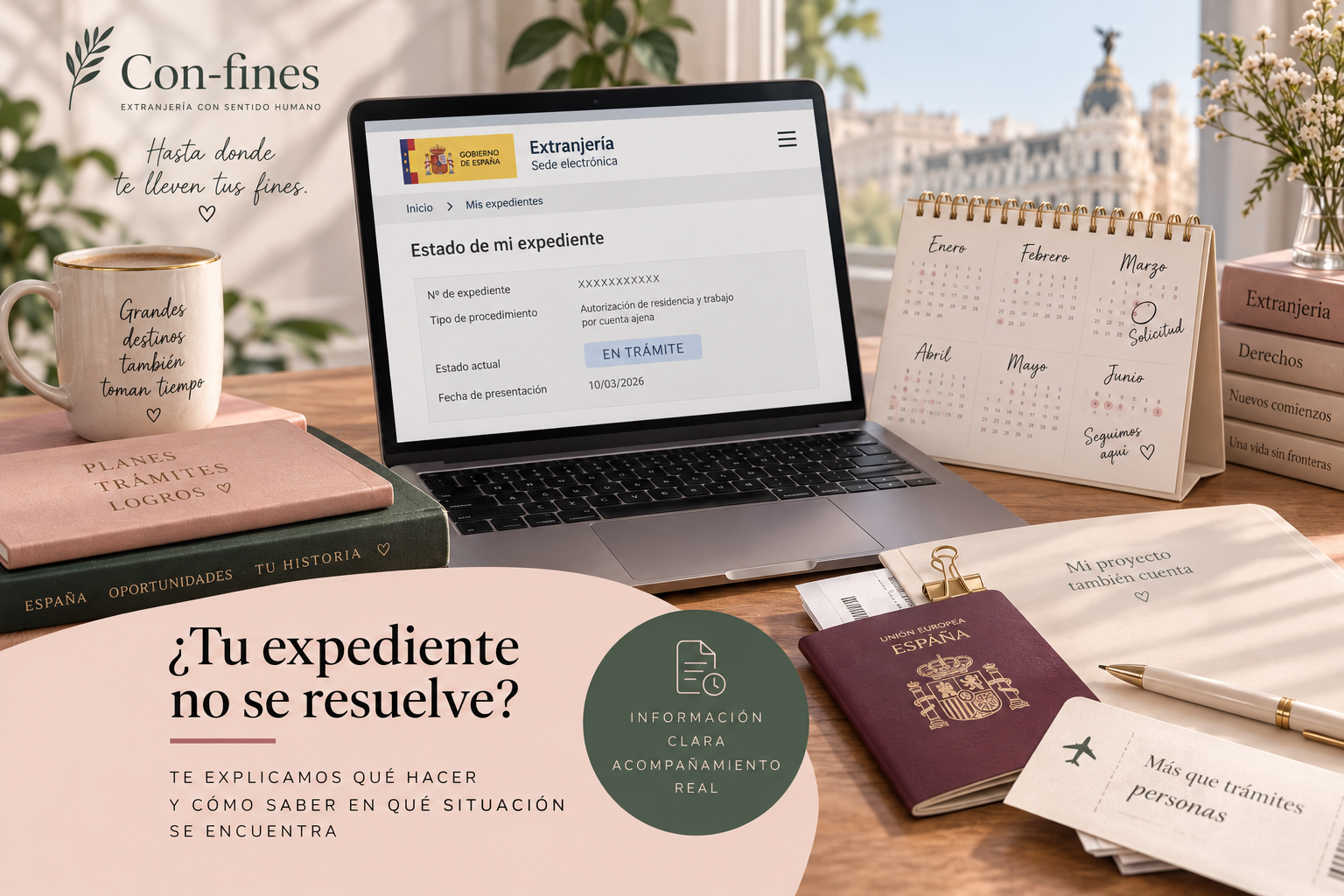
You submitted your application months ago, you check its status and it still says “En trámite” (In progress). Does that mean there is a problem with your application?
Not necessarily.
The legal deadline and the actual processing time are not always the same
As a general rule, Spanish immigration authorities have a maximum period of three months to issue and notify a decision on an immigration application, calculated from the day after the application is received by the competent authority. However, some procedures are subject to different specific deadlines.
This is established in Additional Provision One of Organic Law 4/2000 on the rights and freedoms of foreign nationals in Spain and further developed in Additional Provision Seven of Royal Decree 1155/2024, approving the Immigration Regulations.
Read the official Organic Law 4/2000 on Immigration
Read the official Immigration Regulations (Royal Decree 1155/2024)
However, the statutory deadline and the actual processing time do not always coincide. In practice, some applications can take longer to be decided.
How can I find out which applications the Immigration Office is currently processing?
Some Immigration Offices publish estimated processing dates for different types of immigration applications, usually on a monthly basis.
For example, an office may indicate that it is currently processing arraigo applications submitted during a particular month, while renewals, initial residence and work permits, family reunification applications or other procedures may be at a different stage.
This information can give you a much more realistic idea of the actual processing times for your specific procedure at that Immigration Office.
If you submitted your application several months ago and it is still shown as “En trámite”, we can check whether the competent office is already processing applications of the same type submitted after yours, or whether it is still working through earlier applications.
These dates are only indicative. They do not mean that every application submitted on a particular date will be decided at the same time, nor do they replace the statutory deadlines. Each application may require different checks, and processing times may also be affected by requests for additional documents.
In addition, not every Immigration Office publishes this information, and the way in which it is provided may vary from one province to another.
What happens once the three-month deadline has passed?
In many Spanish immigration procedures, if the maximum statutory period expires without a decision being notified, negative administrative silence (silencio administrativo negativo) applies.
However, this is important: negative administrative silence is not the same as receiving an express refusal.
The effects of the expiry of the statutory deadline are regulated by Additional Provision One of Organic Law 4/2000and Additional Provision Eight of the Immigration Regulations.
In addition, Article 24.2 of Law 39/2015 on the Common Administrative Procedure of Public Administrationsprovides that a deemed rejection resulting from administrative silence allows the applicant to pursue the applicable administrative or judicial appeal.
Even where negative administrative silence applies, the Administration remains legally required to issue an express decision. Articles 21 and 24.3 of Law 39/2015 establish this obligation and allow the Administration to subsequently issue a decision without being bound by the negative effect of administrative silence.
This is why an application can remain “En trámite” even after three months and later receive a favourable decision.
There are also certain immigration procedures in which the applicable legislation provides for positive administrative silence, so the rules must always be checked for the specific procedure concerned.
Read Articles 21, 22 and 24 of Law 39/2015
Can a request for additional documents affect the deadline?
Yes.
Article 22 of Law 39/2015 provides for several circumstances in which the maximum period for issuing a decision may be suspended.
These include situations where the applicant is asked to correct deficiencies or provide documents required to process the application. In these circumstances, the calculation of the deadline may be suspended between notification of the request and compliance with it, subject to the limits established by law.
This means that determining whether the statutory deadline has actually expired is not always as simple as counting three months from the date the application was submitted.
Can I continue working if more than three months have passed?
This is particularly relevant for people who applied under Spain’s 2026 extraordinary regularisation process and were granted provisional authorisation to reside and work while their application was being processed.
Royal Decree 316/2026, which introduced Additional Provisions 20 and 21 into the Immigration Regulations, expressly regulates this provisional authorisation and establishes a maximum processing period of three months.
The Directorate-General for Migration Management (Dirección General de Gestión Migratoria) subsequently clarified that, for these applications, the expiry of the three-month period and the resulting negative administrative silence does not, in itself, terminate the provisional authorisation to reside and work in Spain.
That provisional authorisation remains valid until an express decision is issued and formally notified.
Read the Interpretative Guidance issued by the Directorate-General for Migration Management on 22 July 2026
So, what can I do if my application is taking too long?
Before deciding what action to take, it is important to check:
- the type of application submitted and its statutory processing deadline;
- the exact date on which it was submitted;
- whether you received any request for additional documents that may have affected the calculation of the deadline;
- the effect of administrative silence for that particular procedure; and
- where the competent Immigration Office publishes this information, the current estimated processing dates for your specific type of application.
Depending on your circumstances, it may be appropriate to continue waiting, submit a formal written request to the Administration, or consider the available administrative or judicial remedies.
Our CON/FINES Team Value Proposition
At Con-fines, we can review what is happening with your application
If your application is taking longer than expected, at Con-fines we can review your case, the applicable statutory deadline and, where official information is available, the estimated processing dates published by the competent Immigration Office for your type of application.
This allows us to compare your waiting time with the current processing pace for similar applications and assess whether the delay is unusual.
We can also determine whether administrative silence has occurred and explain what options are available in your particular case.
Because the fact that three months have passed does not necessarily mean that your application has been refused — nor does it mean that you simply have to keep waiting without knowing what is happening.
Has your application been showing as “En trámite” for months? Contact Con-fines and we’ll review your case.
Tags
- Immigration
- Administrative Deadlines
- Administrative Silence
- 2026 Regularization
Frequently asked questions
We answer the most common questions on this topic.
What happens if my immigration application has been pending for more than three months?
The fact that three months have passed does not automatically mean that your application has been refused. We need to check the deadline applicable to your specific procedure, whether administrative silence has occurred, and whether there has been any reason for the deadline to be suspended.
If I haven’t received a response from the Immigration Office after three months, does that mean my application has been refused?
No. In procedures where negative administrative silence applies, it allows you to pursue the relevant appeal options, but it is not the same as receiving an express refusal. The Administration remains legally required to issue a decision.
Can the Immigration Office approve my application after negative administrative silence has occurred?
Yes. Under Article 24.3(b) of Law 39/2015, where administrative silence has a negative effect, a subsequent express decision is not bound by that negative outcome. Therefore, your application may still receive a favourable decision even after the statutory deadline has expired
Do all Spanish immigration applications have a three-month processing deadline?
No. Three months is the general maximum period applicable to many immigration authorisations, but some procedures have their own specific deadlines. The rules applicable to your particular application must always be checked.
How can I find out which application dates the Immigration Office is currently processing?
Some Immigration Offices periodically publish estimated processing dates for each type of procedure. These can give you an approximate idea of which submission dates are currently being processed, although they are only indicative and do not replace the statutory deadlines.
Can a request for additional documents delay the processing deadline?
Yes. Article 22 of Law 39/2015 provides for circumstances in which the maximum period for issuing a decision may be suspended, including certain requests to correct deficiencies or provide additional documentation.
What does “En trámite” mean on my immigration application?
It means that no final decision is currently shown in the application status system. How long your application remains at this stage will depend on the type of procedure, the competent Immigration Office and the specific circumstances of your case.
Can I submit a formal request if my application has been pending for a long time?
Depending on the circumstances, it may be appropriate to submit a formal written request to the Administration. Before doing so, it is advisable to review the statutory deadline, the current status of your application, any requests for additional documents and the effect of administrative silence.
Can I appeal if the Immigration Office does not respond?
Where negative administrative silence applies, it allows you to pursue the relevant appeal procedures. The appropriate type of appeal and its effects will depend on the specific procedure and the circumstances of your case.
Can I continue working if my application has been pending for more than three months?
It depends on the procedure. For example, for certain applicants under Spain’s 2026 extraordinary regularisation process, the Directorate-General for Migration Management has clarified that negative administrative silence does not, by itself, terminate the provisional authorisation to reside and work. This authorisation remains valid until an express decision is formally notified.
Official source
- Spanish act·Ley Orgánica 4/2000, de 11 de enero, sobre derechos y libertades de los extranjeros en España y su integración social read the full text →
- Royal Decree·Real Decreto 1155/2024, de 19 de noviembre, por el que se aprueba el Reglamento de Extranjería read the full text →
- Spanish act·Ley 39/2015, de 1 de octubre, del Procedimiento Administrativo Común de las Administraciones Públicas read the full text →
- Royal Decree·Real Decreto 316/2026, de 14 de abril, por el que se modifica el Reglamento de Extranjería (regularización extraordinaria) read the full text →
Written by
Equipo legal Con Fines
CON/FINES
The information on this page is indicative and updated in line with current regulations. Timing largely depends on the competent authority.
Related services
These services relate to what you have just read.