Written by Equipo Legal Con Fines · 2026-10-01 · Last updated: 2026-10-01
Can I Bring My Partner or Children to Live in Spain? The 3 Main Family Residence Routes
Do you live in Spain and want your partner or children to come and live with you?
One of the most common questions in Spanish immigration law is whether someone who already lives in Spain can bring their family members and help them obtain permission to live and work here.
The answer is yes, in many cases it is possible. However, not every family follows the same immigration procedure.
The appropriate residence permit will mainly depend on your nationality, your immigration status in Spain and your relationship with the family member you want to bring.
In this guide, we explain the three main routes, their differences and what you should consider before starting the process.
What Options Are Available to Bring Your Family to Spain?
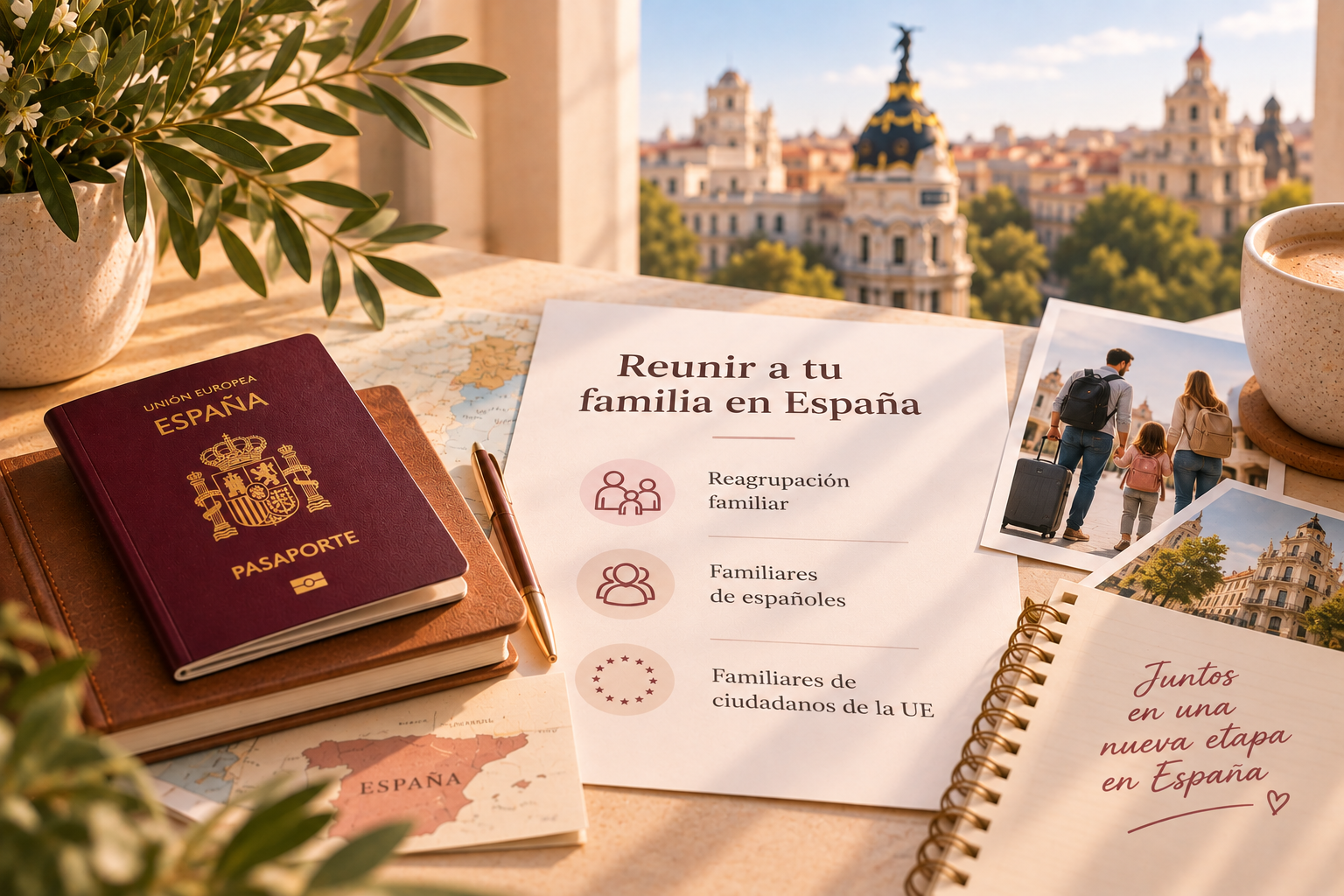
There are three main routes to consider:
1. Family reunification under the general immigration regime. For foreign nationals who legally reside in Spain and want to bring certain family members.
2. Residence permits for family members of Spanish citizens. For foreign family members of Spanish nationals, under Articles 93 to 98 of the Spanish Immigration Regulations.
3. Residence cards for family members of EU citizens. For non-EU family members of citizens of other EU Member States, the European Economic Area (EEA) or Switzerland who meet the requirements of the EU free movement regime. This route may also apply to family members of Spanish citizens in certain situations involving the exercise of EU free movement rights.
You should not choose an immigration procedure based solely on your family relationship. First, you need to determine which legal regime applies to the person living in Spain.
1. Family Reunification: If You Are a Foreign National Legally Residing in Spain
Family reunification allows a foreign national who legally resides in Spain to apply for a residence permit for certain family members.
It is mainly regulated by Articles 65 to 68 of Royal Decree 1155/2024.
Which Family Members Can You Bring?
Eligible family members may include:
- Your spouse, provided the legal requirements are met.
- Your registered partner or a duly documented stable partner.
- Your children under 18.
- Children under 18 of your spouse or partner, subject to the applicable conditions.
- Certain adult children who require support due to a disability or who are objectively unable to meet their own needs for health-related reasons.
- Certain parents or other direct relatives in the ascending line, subject to additional requirements.
Not all family members qualify under the same conditions.
How Long Must I Have Lived in Spain?
As a general rule, you can apply for family reunification once you have legally resided in Spain for at least one year and applied for authorisation to reside for at least another year.
Special rules apply in certain situations, particularly when bringing parents or other qualifying ascendants, or when the sponsoring family member holds long-term residence status.
Do I Need to Prove My Income?
Yes. Under the general immigration regime, you must normally demonstrate sufficient financial resources to support your family.
As a general reference, a family unit of two people must demonstrate 150% of the IPREM (Spain's Public Income Indicator), with an additional 50% of the IPREM for each extra family member.
However, the regulations provide special rules and possible reductions when reuniting with minors or people under legal representation. Therefore, a fixed financial threshold does not necessarily apply in every case.
You must also demonstrate that you have adequate accommodation, where required.
How Does the Application Process Work?
Generally, the procedure involves the following steps:
The person legally residing in Spain submits the family reunification application to the Immigration Office (Oficina de Extranjería).If the authorisation is approved, the family member applies for the corresponding visa at the competent Spanish consulate.Once the visa is granted, the family member travels to Spain.After arrival, the family member applies for a Foreigner Identity Card (Tarjeta de Identidad de Extranjero, or TIE), where applicable.
Important: the fact that your partner or children can enter Spain as tourists does not automatically mean they can use that entry to complete a family reunification procedure under the general immigration regime.
2. Residence Permits for Family Members of Spanish Citizens: If You Have Spanish Nationality
If you are a Spanish citizen and want your foreign partner or children to live with you in Spain, there is a specific residence authorisation: the temporary residence permit for family members of Spanish nationals.
It is regulated by Articles 93 to 98 of Royal Decree 1155/2024.
Which Family Members Can Apply?
Eligible family members may include:
- A spouse over 18.
- A registered partner.
- A duly documented stable partner.
- Your own children or those of your spouse or partner, generally under 26, as well as certain older children who are financially dependent or require support due to a disability.
- Certain parents or other direct relatives in the ascending line.
- The father, mother or legal guardian of a Spanish minor, provided the applicable requirements are met.
- Other family members expressly covered by the regulations.
One particularly important difference concerns the age of children: the residence regime for family members of Spanish citizens generally includes children under 26, while ordinary family reunification normally uses an age limit of 18.
Do We Have to Be Married?
Not necessarily.
The regulations also recognise registered partners and duly documented stable relationships.
For an unregistered stable relationship, the relationship is generally considered sufficiently established when the couple has lived together in a marriage-like relationship for at least 12 consecutive months.
This prior cohabitation period is not required when the couple has children together and the relationship continues.
However, this does not mean that any romantic relationship qualifies for a residence permit. The relevant legal conditions must be demonstrated.
Do I Need to Earn a Minimum Salary to Bring My Partner?
You should not confuse this residence permit with family reunification under the general immigration regime.
The residence permit for family members of Spanish citizens does not generally impose the same 150% IPREM income requirement that applies to ordinary family reunification.
However, applicants must still meet the specific requirements of this residence category and demonstrate the relevant family circumstances or dependency where applicable.
Can the Application Be Submitted from Spain?
It depends on the family relationship and where the family members are located.
The regulations allow certain family members to submit their applications from within Spain, but not every situation follows the same procedure.
For example, when both people are in Spain, spouses, registered or stable partners, and certain other family members covered by the regulations may be able to apply through the Immigration Office.
In other situations, if the family member is abroad, the procedure may need to begin in Spain or at a Spanish consulate, depending on the circumstances.
That is why it is important to check the applicable procedure before making travel arrangements.
How Long Is This Residence Permit Valid?
As a general rule, the permit is granted for five years, unless a shorter period applies under the regulations.
It also allows the holder to live and work in Spain, either as an employee or on a self-employed basis, without needing a separate work authorisation.
3. EU Citizen Family Residence Card: If Your Partner or Family Member Is an EU Citizen
If the person you want to join is a citizen of another European Union Member State, such as Italy, France, Germany or Portugal, you may qualify for a residence card as a family member of an EU citizen.
This regime is mainly regulated by Royal Decree 240/2007.
It also covers family members of citizens of the European Economic Area and Switzerland.
Who Can Apply?
Eligible family members may include, subject to the relevant conditions:
- A spouse.
- A registered partner.
- An unregistered stable partner, where the relationship is sufficiently documented.
- Children under 21.
- Children over 21 who are financially dependent or meet certain disability-related conditions.
- Certain dependent parents or other direct relatives in the ascending line.
- Other family members who can demonstrate dependency, previous cohabitation or other circumstances recognised by the regulations.
Does the EU Citizen Have to Be Employed?
Not necessarily.
The EU citizen must meet the conditions for residing in Spain for more than three months.
For example, they may:
- Be employed.
- Be self-employed.
- Have sufficient financial resources and appropriate healthcare coverage.
- Be a student who meets the relevant financial and healthcare requirements.
Therefore, having an employment contract is not mandatory, but the EU citizen must demonstrate that they meet one of the applicable conditions.
What If My Family Member Is Spanish?
There is an important distinction here.
As a general rule, foreign family members of Spanish citizens use the specific residence permit for family members of Spanish nationals.
However, if the Spanish citizen has exercised their right to free movement within the European Union, there may be situations in which the EU free movement regime applies.
Therefore, it is not correct to assume that every family member of a Spanish citizen must always apply for an EU family residence card.
What Is the Difference Between These Three Residence Permits?
Although all three routes can allow family members to live together in Spain, they have different requirements.
If you are a foreign national legally residing in Spain: you will normally need to consider family reunification under the general immigration regime, including its requirements concerning previous residence, financial resources and accommodation.
If you are a Spanish citizen: the specific residence permit for family members of Spanish nationals will generally apply.
If you are a citizen of another EU Member State, the EEA or Switzerland: the EU citizen family residence card will normally be the relevant option.
Furthermore, the age limits for children, financial requirements and application procedures are not the same.
For example, a Colombian national legally residing in Spain who wants to bring their 17-year-old child will not necessarily be in the same legal situation as a Spanish citizen who wants to bring their 24-year-old child.
Can I Bring My Partner's Children Even If They Are Not My Biological Children?
Yes, this may be possible.
All three routes include certain circumstances in which the children of a spouse or partner may qualify, subject to their respective requirements.
However, when minors will not be living with both parents, it is particularly important to review:
- Who holds parental responsibility.
- Who has legal custody.
- Whether authorisation from the other parent is required for the child to establish residence in Spain.
- The documents proving parentage and the family's legal circumstances.
Simply demonstrating that you are in a relationship with the child's mother or father is not always sufficient.
What If My Partner and I Are Not Married?
Being unmarried does not necessarily prevent you from applying for a family residence permit.
All three routes recognise, under different conditions, registered partnerships or stable relationships.
However, being boyfriend and girlfriend, maintaining a long-distance relationship or visiting each other in different countries does not automatically establish a stable partnership for Spanish immigration purposes.
In some cases, previous cohabitation is required. In others, the relationship may be demonstrated through the circumstances recognised by the applicable regulations.
It is therefore advisable to assess your situation before deciding whether to marry, register a partnership or submit a residence application directly.
Will My Partner or Children Be Allowed to Work in Spain?
This depends on the type of residence permit and the person's age.
Family reunification: the residence authorisation granted to a reunited spouse, partner or child allows them to work once they have reached the minimum legal working age, without needing a separate work permit.
Family members of Spanish citizens: the residence authorisation generally allows employment and self-employment.
Family members of EU citizens: the residence card recognises the right to live and work in Spain under the conditions established by the EU free movement regime.
In every case, the applicable employment regulations must be respected, particularly where minors are concerned.
What Documents Do I Need to Bring My Family to Spain?
The documents required depend on the procedure, but you will generally need to prepare:
- A valid passport for the foreign family member.
- Identity and residence documents for the person living in Spain.
- A marriage certificate, partnership registration certificate or evidence of a stable relationship.
- Birth certificates for children.
- Custody documents or authorisation from the other parent, where applicable.
- Evidence of financial dependency, where required.
- Proof of income, accommodation or healthcare coverage, depending on the procedure.
- Any additional documents specifically required for the residence category.
Foreign documents may need an apostille or legalisation and an official translation, unless an applicable exemption exists.
You can also read our guide to apostilles and sworn translations on the Con-fines blog.
Can I Bring My Family If I Am Still Waiting for My Residence Permit Renewal?
This depends on the type of residence authorisation you hold, the procedure you want to initiate and your immigration status.
For ordinary family reunification, the regulations establish specific rules concerning previous residence and renewal of the sponsoring family member's authorisation.
Other residence regimes have different conditions.
Therefore, before submitting an application, it is important to confirm that your current immigration status allows you to use the chosen route and that you meet the requirements at the relevant time.
Our CON/FINES Team Value Proposition
Want to Bring Your Partner or Children to Live in Spain?
At Con-fines, we can assess your circumstances and determine which immigration procedure applies based on your nationality, residence authorisation and relationship with your family members.
We can also help you check the requirements, prepare the necessary documents and submit the appropriate application.
Choosing the correct procedure from the beginning can help you avoid additional document requests, delays and unnecessary expenses.
Because bringing your family together in Spain starts with understanding which legal route applies to your situation.
Want your family to live with you in Spain? Let's talk.
Tags
- Spanish Immigration
- Family Reunification
- Family Members of Spanish Citizens
- EU Citizen Family Members
- Residence in Spain
Frequently asked questions
We answer the most common questions on this topic.
Can I Bring My Husband or Wife to Spain If I Have a Residence Permit?
Yes, provided you meet the requirements for family reunification or another residence authorisation applicable to your circumstances.
Can I Bring My Boyfriend or Girlfriend Without Being Married?
It may be possible if you have a registered partnership or a stable relationship that meets the requirements of the relevant procedure. Simply stating that you are in a romantic relationship is not sufficient.
Can I Bring My 20-Year-Old Child to Spain?
It depends. Under ordinary family reunification, children over 18 are generally excluded except in certain circumstances. The residence regime for family members of Spanish citizens generally includes children under 26, while the EU regime generally uses an age limit of 21, with additional possibilities where dependency or other circumstances exist.
If I Have Spanish Citizenship, Do I Need to Apply for Family Reunification?
Generally, the ordinary family reunification procedure does not apply. Instead, the specific residence permit for family members of Spanish citizens is normally appropriate. The EU free movement regime may apply in certain circumstances.
Do I Need to Have a Job to Bring My Partner?
It depends on the procedure. Ordinary family reunification requires sufficient financial resources, while the residence regimes for family members of Spanish citizens and EU citizens have different requirements.
Can I Bring My Partner's Children?
Yes, in certain circumstances. Their age, family relationship, the parent's residence status and, where applicable, parental responsibility, custody or authorisation from the other parent must be reviewed.
Can My Family Member Enter Spain as a Tourist and Then Apply for Residence?
There is no single answer. Some procedures allow applications to be submitted from within Spain under certain circumstances, while others require an authorisation and visa procedure from abroad. It is important to check before travelling.
How Long Does the Process Take?
Legal processing deadlines and actual waiting times vary depending on the residence authorisation, the competent Immigration Office and, where involved, the consulate. The residence decision, visa procedure and issuance of the TIE must also be considered separately.
Does a Family Residence Permit Allow the Holder to Work?
In many of these situations, yes. However, the specific residence authorisation and applicable conditions must be checked.
Official source
- Royal Decree·Real Decreto 1155/2024 — Reglamento de Extranjería, artículos 65 a 68 y 93 a 98 read the full text →
- Other source·Hoja 8 — Autorización de residencia temporal por reagrupación familiar read the full text →
- Other source·Hoja 18 — Autorización de residencia temporal de familiares de personas con nacionalidad española read the full text →
- Other source·Hoja 62 — Tarjeta de residencia de familiar de ciudadano de la Unión Europea read the full text →
- Royal Decree·Real Decreto 240/2007 — Régimen de ciudadanos de la Unión Europea y sus familiares read the full text →
Written by
Equipo Legal Con Fines
CON/FINES
The information on this page is indicative and updated in line with current regulations. Timing largely depends on the competent authority.
Related services
These services relate to what you have just read.